Parent questions
How do I use screen time for the Quran instead of against it?
A screen is a delivery tool, not a teacher. Choose, Watch, Connect, Close.
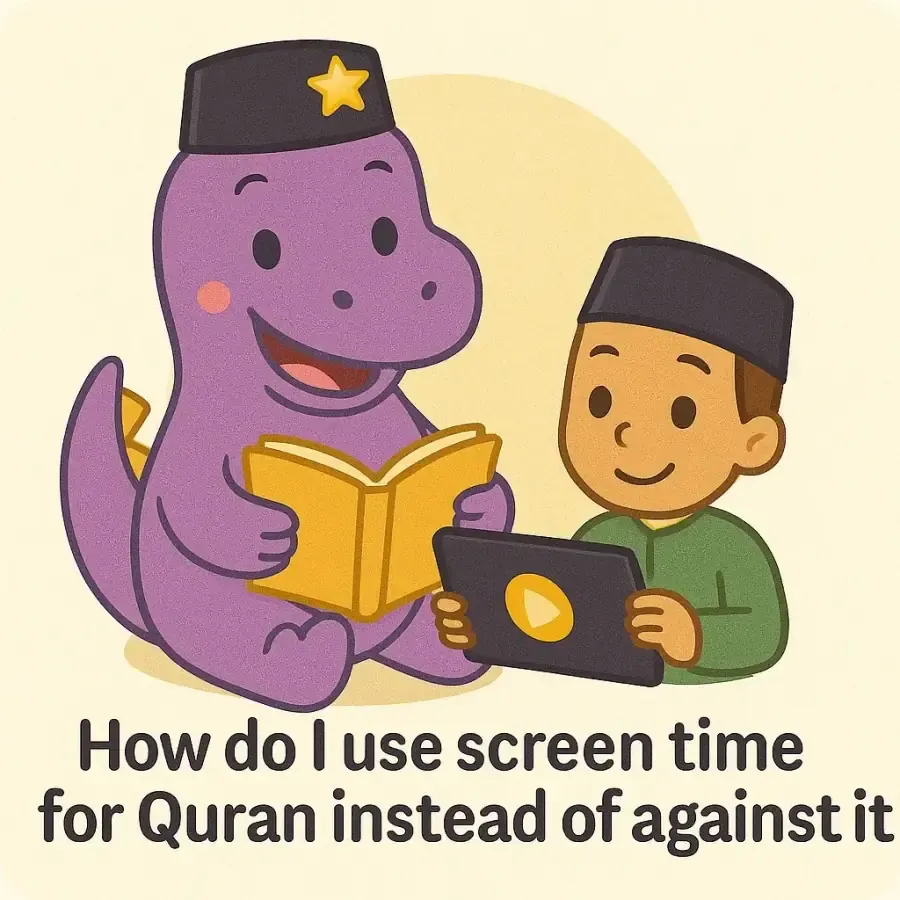
You say, "Please put the phone away." Your child says, "But I'm watching something Islamic!" Is every Islamic video beneficial? Does a Quran app automatically make screen time healthy?
A screen is a delivery tool. It is not a curriculum, a teacher or a substitute parent. Its value depends on what it shows, how it is used, what it replaces and what happens afterwards. We suggest four steps: Choose, Watch, Connect, Close.
Choose
Before your child taps play, an adult decides whether the resource is suitable. Is the Arabic recitation accurate? Can the story be traced to the Quran or authentic Sunnah? Have religious claims been reviewed by qualified teachers? Is the language right for your child's age? Are there ads, unsuitable recommendations or sensational claims about prophets and miracles? Cheerful colours don't make an app trustworthy.
Watch
Pick one episode instead of an endless queue. Set a time limit that suits your child's age; for a very young child, that might be a few minutes watched together. There is no one safe number for every child. Follow paediatric guidance and your own family's needs.
Connect
This is where a video can become family learning. Suppose you watch a short explanation of the bee mentioned in Surah An-Nahl. When it ends, ask, "What was new?" Then open a verified translation of Quran 16:68–69 and read an age-appropriate explanation. Later, look at real bees in a park, from a safe distance. The screen was an invitation to look at Allah's creation, not the whole lesson.
We do a lot of this kind of looking at home. When we cleaned blue swimmer crabs at the sink, the children stopped to look at the serrated edges of the claws. Our Signs Lab tool is made for the same habit of investigating a sign in creation: https://iqrasaurus.com/signslab
Close
End on purpose. Turn off autoplay and put the device down. Then do something in the physical world: draw, read together, help someone, or talk over a meal.
Your own screen
If a parent keeps checking messages during Quran time, the child learns that attention is optional. You don't need to be screen-free, only to give a short span of full attention. If you work or care for another child, plan a routine you can keep rather than promising a daily half-hour you can't.
Three house rules to discuss
- We don't let unknown algorithms decide our Islamic education.
- We check religious claims with trustworthy sources.
- After we watch, we talk or do something meaningful.
Avoid "Watch a Quran video and earn another hour of gaming", as if recitation were a ticket to something better. Celebrate effort, and let the learning stand on its own.
If screens already cause arguments, change things gradually. Give a clear stopping point, offer a predictable offline activity, and stay consistent without humiliating your child.
Try this week
Choose one trustworthy five- or ten-minute programme. Watch it together, connect it to one authentic verse, and finish with one small offline action.