Parent questions
Am I teaching the Quran correctly to my child?
Two things go together: kindness in how you teach, and care that what you teach is accurate.
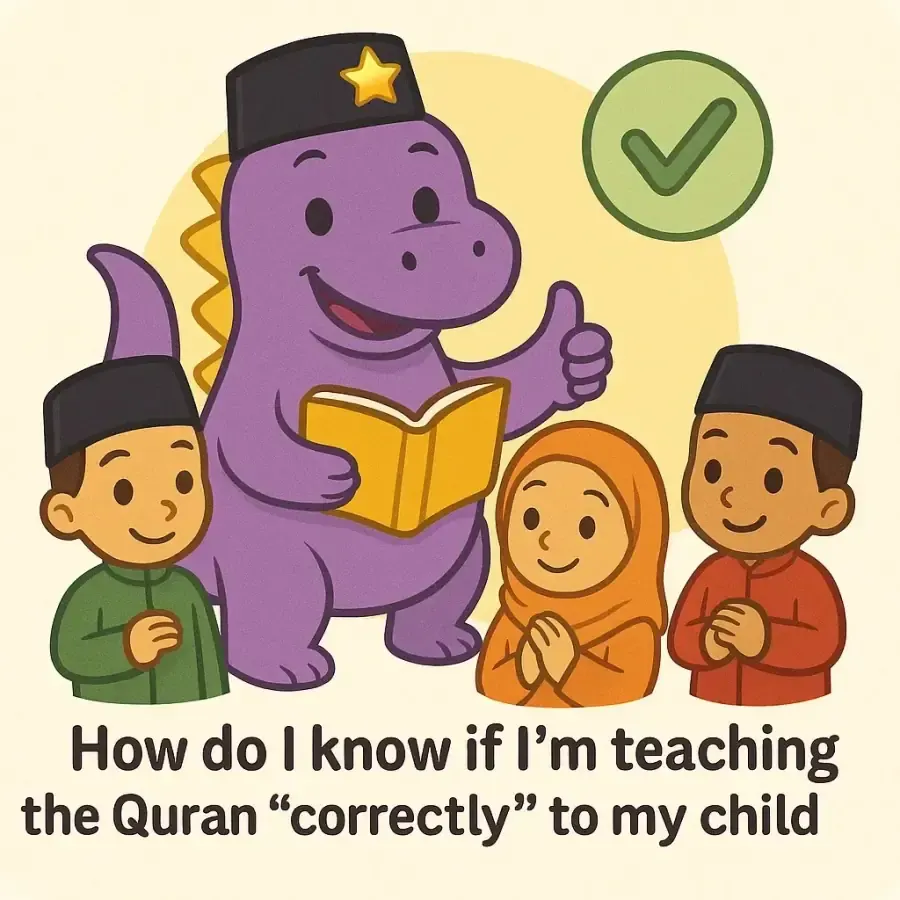
You are halfway through explaining a verse when your child asks something you can't answer. Your tajwid may be shaky too. "Am I doing this right?"
The answer needs both reassurance and standards.
What can vary, and what must be right
There are many good ways to help children learn: listening, guided repetition, stories, questions, drawing and daily practice. Some things must be correct: the Quran's wording, the difference between the Quran and its translations, careful handling of tafsir and proper attribution of hadith. A joyful lesson is not automatically an accurate one.
Allah calls people toward His way with wisdom and good instruction (Quran 16:125). That supports gentleness. It does not allow us to make up meanings.
Three questions to ask yourself
- Am I using a reliable Quran text and reciter?
- Am I relying on trustworthy teaching rather than inventing explanations?
- Am I treating my child kindly as they learn?
A common moment
Your child asks, "Does Surah Al-Fil mean Allah will stop every scary thing from happening to us?" You could say, "The surah tells a real event in which Allah defeated the people of the elephant. We turn to Allah for help and protection, but people can still go through difficulties. Let's ask our teacher how to understand this better." That is more honest than promising something the verse does not promise.
Correcting ourselves
When you make a mistake, correct it. If you mispronounce a word, get help. If you repeated a story detail without evidence, say so. Children learn something valuable when a parent respects the truth enough to take a statement back.
We work the same way. IqraSaurus is led by ARS-recognised asatizah and operated as an IECP in Singapore. Our printables are checked by asatizah before we share them, and when someone points out a mistake in our pages or tools, we fix it.
Try this week
Keep a "Questions for our teacher" list on the fridge. Each time your child asks something you aren't sure of, write it down, and take the list to your child's ustaz or ustazah.