Parent questions
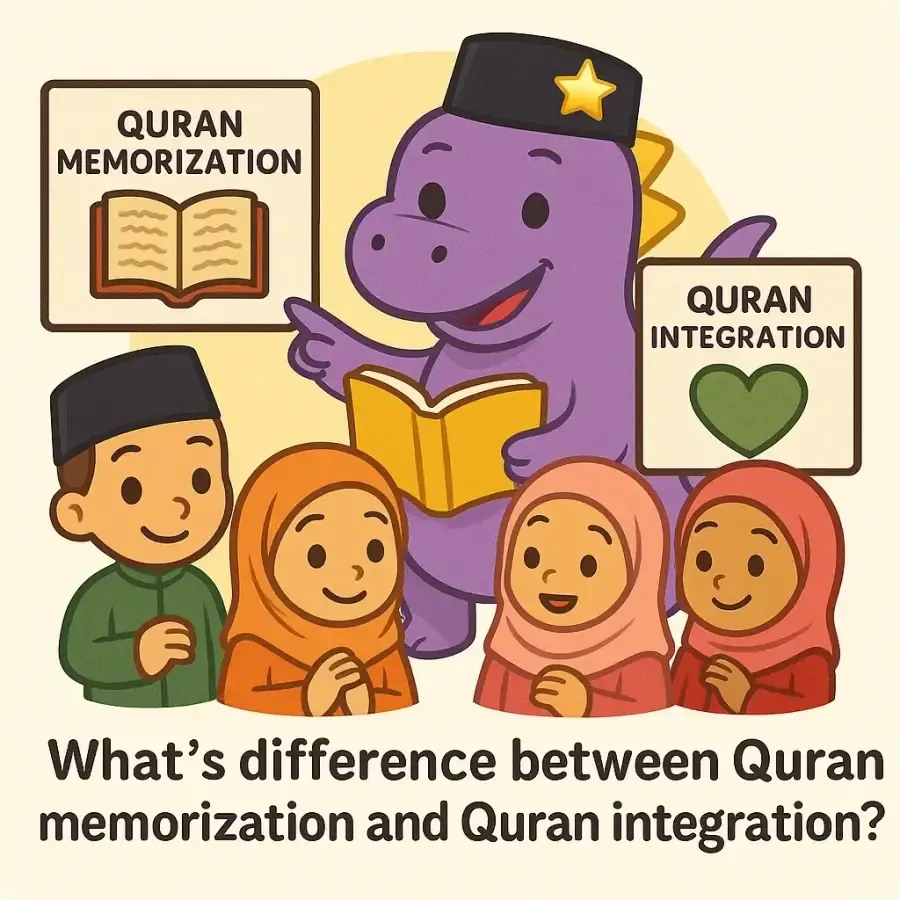
What is the difference between memorising the Quran and living it?
Memorising is worship in itself. Understanding and practice grow alongside it, at a child’s pace.
Your child recites Surah Al-Asr beautifully. Five minutes later there is an argument over the remote control, and you wonder whether memorising made any difference.
Before answering, remember that a child is still learning self-control. One hard moment does not mean the Quran lessons failed.
Memorising is worship
Memorising the Quran is a noble form of worship and learning in itself. Correct recitation, repeated listening, understanding, reflection and conduct are not competitors. They are different ways of relating to Allah's revelation, and they support one another. So we never call memorisation an empty shell.
How we memorise
The method we use came from our teacher and mentor, Dr Syafiee, who used it with his own eleven children, all of whom became huffaz. Take one ayah and read it in a cycle of 25: five times with your eyes open, five with them closed, five open, five closed, five open. By then the line is usually memorised. Then do the same for chunks of lines. Twenty to twenty-five repetitions is the basic level; it can go up to sixty. Earlier verses of the surah are revised ten times a day.
We put this into a Juz 'Amma Hifz Logbook for our children, and it later grew into our Mini Hafiz tool: https://iqrasaurus.com/hafiz
How living it looks
Learn and recite Surah Al-Asr. Then read an age-appropriate, trustworthy explanation: Allah swears by time and describes the qualities of those saved from loss, which are faith, righteous deeds, truth and patience. Then ask, "Can our family use ten minutes well by helping someone?" That is an application. It does not replace tafsir.
For adults, we made reflection pages for Surah Al-Mulk in 2019, one page for each of its 30 ayat. Each page goes from the ayah to things to do. On the page for the ayah about death and life, Integrate includes saying Innalillahi when we hear of a death and making dua for a newborn, and Impart includes going to funerals and to baby celebrations.
A gentle week
- Monday: recite.
- Tuesday: revisit a key word.
- Wednesday: share a story or reflection.
- Thursday: do a related good deed.
- Friday: ask your child to explain what they remember.
- Weekend: go back to the recitation with a teacher's guidance.
Nothing needs to be dramatic. A child helping to set the table, telling the truth after a mistake or being patient can start a conversation about faith.
Don't treat every tantrum as a test of whether the Quran is "working". Keep expectations that fit your child's age and avoid spiritual labels. One action does not show a child's spiritual state, and a certificate doesn't either.